Concrete Driveway Costs Rise 15% as Cement Prices Surge Across New Zealand
- Concrete driveway costs have risen from $80-120/m² to $95-140/m² across New Zealand in the past 12 months.
- Cement price increases of 18-22% are driving the bulk of cost escalation, with regional variations up to $15/m² between centres.
- Alternative paving materials like exposed aggregate and stamped concrete are becoming more cost-competitive as plain concrete prices climb.
Concrete driveway pricing breakdown
Current pricing breakdown
Standard 100mm thick concrete driveways now run $95-140/m² including labour across most New Zealand centres, with Auckland hitting the top end at $130-140/m². The base cost breaks down to roughly $45-55/m² for materials and $50-85/m² for professional installation. Canterbury and Otago sit at the lower end around $95-115/m², while Wellington tracks closer to Auckland pricing at $120-135/m².
The jump reflects cement costs rising from $180-200 per tonne to $220-250 per tonne since mid-2025. Ready-mix concrete has followed suit, climbing from $140-160/m³ to $170-190/m³ depending on your supplier and location. Reinforcing mesh has stayed relatively stable at $8-12/m², but aggregate costs have crept up 8-10% in most regions.
What’s driving the increases
Three main factors are pushing concrete driveway costs higher. Global cement supply chain disruptions continue affecting New Zealand imports, with shipping costs remaining elevated despite some stabilisation. Local cement production capacity hasn’t kept pace with construction demand, particularly around major centres where residential development stays strong.
Energy costs for cement manufacturing have also jumped significantly. The carbon-intensive production process means manufacturers are paying more for power while also factoring in emissions pricing. Labour shortages in the concrete industry compound the problem — experienced concreters can now command $35-45 per hour compared to $28-38 twelve months ago.
Regulatory changes around low-carbon concrete requirements under the Building Code are starting to bite too. While NZS 3109 still allows standard mixes for residential driveways, some councils are pushing for reduced-emission options that cost 10-15% more per cubic metre.
Comparing your options
Plain concrete remains the most cost-effective choice for basic driveways, but the price gap with decorative alternatives is narrowing. Exposed aggregate now runs $110-165/m² compared to $100-150/m² previously — only $15-25/m² more than standard concrete in most areas.
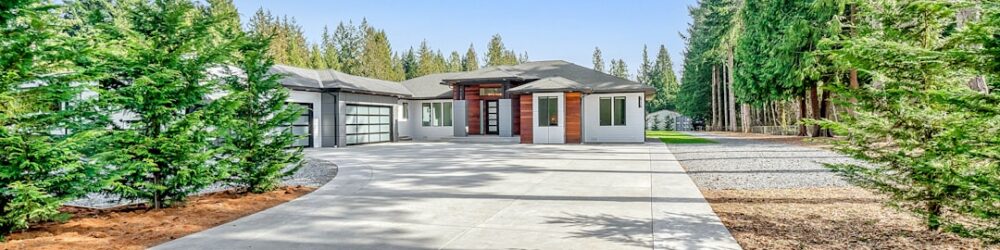
Stamped concrete patterns add $25-40/m² over plain concrete, bringing total costs to $120-180/m². Coloured concrete commands a $15-30/m² premium. Asphalt driveways remain cheaper at $65-90/m², but the lifespan trade-off makes concrete more attractive long-term despite the higher upfront cost.
Paver options have become less competitive. Concrete pavers now run $140-200/m² installed, while clay pavers hit $180-280/m². Natural stone starts around $250/m² for basic options.
Timing considerations
Most contractors expect concrete prices to stabilise rather than drop significantly through late 2026. The smart money suggests booking work for autumn 2027 if you can wait — winter pricing traditionally runs 5-10% lower, and supply chains may have better adjusted by then.
For immediate projects, getting multiple quotes becomes even more critical. Price variations of $20-30/m² between contractors aren’t uncommon, reflecting different supplier relationships and overhead structures. Mid-tier contractors often offer the best value — avoiding both premium pricing from large firms and potential quality issues with cut-price operators.
Consider staging larger driveways if budget pressure is tight. Most contractors will price stage one competitively to secure the relationship, particularly for jobs over 150m².
Specification impacts
Standard residential driveways require 100mm thickness with SL72 mesh reinforcement to handle typical vehicle loads. Going to 125mm thickness adds roughly $15-20/m² but provides better long-term durability, particularly on clay soils common around Auckland and Hamilton.
Base preparation costs stay consistent at $25-35/m² for proper excavation and AP40 aggregate base. Skimping here to save money typically backfires within 3-5 years through cracking and settlement issues. Proper drainage becomes even more critical with higher concrete costs — you don’t want to redo expensive work due to water damage.
Control joint spacing should follow NZS 3114 recommendations at maximum 6m centres. Some contractors suggest 4-5m spacing for better crack control, adding minimal cost but reducing long-term maintenance headaches.
Other considerations
Weather delays can blow budgets when concrete costs this much. Allow extra contingency for winter work — rain delays on expensive ready-mix concrete hurt more than they used to. Pump truck access may add $300-500 to jobs where trucks can’t reach the pour location directly.
Consider upgrading control joints to saw-cut rather than tooled joints for $3-5/m² extra — cleaner appearance and better crack control justify the premium at current pricing levels. Future concrete repairs will also cost more, making quality workmanship upfront even more valuable than before.